Category: Photos & Videos

Animal (10) Car (13) Cricketer (11) Digital Camera (10) Dramatist (2) Exclusive (25) Flower (2) Funny (13) Game (2) General (10) Great Person (15) Great Scientist (6) Islamic (23) Joker (1) Laptop (10) Leader (4) Millionaire (1) Mobile Phones (14) Model (9) Mosque (22) Motorcycle (8) National Flag (15) Necklaces (10) Pagoda (2) Perfume (7) Poet (2) Powerful Woman (10) Soccer (12) Television (7) Temple (10) Watch (13)
Showing posts with label Animal. Show all posts

Monday, June 24, 2013

Camel

CAMEL

Identity & Taxonomy

KINGDOM: Animalia
PHYLUM: Chordata
CLASS: Mammalia
ORDER: Artiodactyla
FAMILY: Camelidae
GENUS: Camelus (Linnaeus, 1758)
SPECIES: Camelus bactrianus, Camelus dromedarius

Camel
A camel is either of the two species of large even-toed ungulate in the genus Camelus, the Dromedary (single hump) and the Bactrian Camel (double hump). Both are native to the dry and desert areas of Asia and northern Africa. The average life expectancy of a camel is 30 to 50 years. Humans first domesticated camels approximately 5,000 years ago.

Somali Breed Female with Calf

The key diagnostic features of the camel are body length (300 cm), shoulder height (180–210 cm), tail length (50 cm) and weight (600–1000 kg). Camels have a smooth coat that is beige to light brown, with the undersides slightly lighter. Their legs are long and slender, often with calloused knees, developed from where they touch the ground when the animal is lying down. Though often called the one-humped camel, the dromedary has two humps used for energy storage in the form of fat. The under-developed anterior hump sits over the shoulders and the large rear hump is found in the center of the back. The upper lip is deeply split and the nostrils can be closed. The camel has long eyelashes to help to keep sand out of its eyes. The two broad toes on the feet are able to spread widely as an adaptation to walking on sand.

Camels used for entertainment are often subjected to abuse. Even under the best of circumstances, captivity can be hell for animals meant to roam free. Kept in small, barren cages, forced to sleep on concrete slabs, and imprisoned behind iron bars, performing animals often suffer from malnutrition, loneliness, the denial of all normal pleasures and behaviors, loss of freedom and independence, even lack of veterinary care, and filthy quarters. Attracting customers is the first consideration and the animals' welfare is often the last. Even when the mere display of the animals themselves is the "draw," the animals rarely receive proper care--and almost never the socialization and stimulation they crave.

Hippopotamus

The Hippopotamus

Identity & Taxonomy

KINGDOM: Animalia
PHYLUM: Chordata
CLASS: Mammalia
ORDER: Artiodactyla
FAMILY: Hippopotamidae
GENUS: Hippopotamus
SPECIES: H. amphibius
BINOMIAL NAME: Hippopotamus amphibius (Linnaeus, 1758)

Hippopotamus

The hippopotamus or hippo, lives in the hot part of Africa. It is a mammal. That is, its babies are born alive, and they drink milk from the mother’s body. The hippopotamus is a large animal. It weighs four tons. Its stomach is seven meters long, and it eats only plants. It is a mammal, but it spends a lot of time in the water.

During the day, it sleeps beside a river or a lake. Sometimes it wakes up. Then it goes under the water to get some plants for food. It can close its nose and stay under water for ten minutes. Its ears, eyes, and nose are high up on its head. It can stay with its body under the water and only its ears, eyes, and nose above the water. Then it can breathe the air.

At night, the hippo walks on the land and looks for food. It never goes very far from the water. A baby hippo often stands on its mother’s back. The mother looks for food underwater. The baby rides on her back above the water.
Hippopotamus

At a glance, The Hippopotamus:
  • SIZE: The average hippopotamus will stand between 52 and 70 inches tall.
  • WEIGHT: A male hippopotamus will average between 3,530 and 7,040 pounds. Females are smaller, weighing between 1,440 and 5,160 pounds.
  • FOOD HABITS: The hippopotamus is a herbivore, eating only fruits, vegetables, leaves, and grasses.
  • HABITAT: The preferred habitat of this species is deep water with adjacent reed beds and grasslands.

Panda

Panda

Identity & Taxonomy

Binomial Name: Ailuropoda melanoleuca
Kingdom: Animalia
Phylum: Chordata
Class: Mammalia
Order: Carnivora
Family: Ursidae
Genus: Ailuropoda
Species: A. melanoleuca

Panda

Pandas are famous for their black and white markings. The legs, shoulders, ears and oval patches around the eyes are black, and the rest of the coat is white. Good tree climbers, pandas can also swim to escape predators. Pandas use an enlarged wrist bone that looks like a thumb to grasp objects like bamboo.

The giant panda lives in mountainous regions, such as Sichuan and Tibet. Since the latter half of the 20th century, the panda has become an informal national emblem for China, and its image is found on many Chinese gold coins. Despite being taxonomically a carnivore, the panda has a diet that is overwhelmingly herbivorous. The giant panda eats shoots and leaves, living almost entirely on bamboo. Pandas are also known to eat eggs, the occasional fish, and some insects along with their bamboo diet. These are necessary sources of protein. Like other subtropical mammals, the giant panda does not hibernate.


The Giant Panda

At a glance, Panda:
  • STATUS: Endangered.
  • SIZE: Pandas weigh an average of 200 to 300 pounds and reach six feet in length.
  • POPULATION: Only 1,000 pandas exist in the wild and 60 in zoos.
  • LIFESPAN: The panda’s lifespan in the wild is unknown but in captivity averages more than 20 years.
  • RANGE: The shrinking range of the panda is limited to parts of Szechuan, Shensi and Kansu provinces in central and western China.
  • FOOD: Pandas feed mostly on bamboo, a tall woody plant full of fiber. The panda’s digestive system does not absorb the fiber, so it must eat a lot. Pandas also eat flowers, vines, tufted grasses, green corn, honey and rodents.
  • HABITAT: The panda lives in thick bamboo and coniferous forests (evergreens with seed cones) at 8,500 to 11,500 feet elevation.
  • BEHAVIOR: These solitary animals spend most of their days feeding. Although they live in cold forests, pandas do not hibernate. They move to lower elevations during winter to keep warm and to higher elevations in summer to stay cool. They do not have permanent homes but sleep at the bottom of trees and under stumps and rock ledges.

Thursday, June 20, 2013

Giraffe

Identity & Taxonomy

Phylum: Chordata
Class: Mammalia
Order: Artiodactyla
Suborder: Ruminantia
Family: Giraffidae

Giraffe

Giraffes are the tallest of all land mammals. They are well known for their long necks, long legs, and spotted patterns. Giraffes have small "horns" or knobs on top of their heads that grow to be about five inches long. These knobs are used to protect the head in fights.

There is only 1 species of giraffe. However there are several different races or subspecies found in different parts of Africa including: Nigerian, Kordofan, Nubian, reticulated, Baringo, Masai, Thornicroft’s, Southern, and Angolan. The different subspecies have different markings. Giraffe are browsers – preferring to eat leaves and bark from the branches of trees. Giraffe feed mostly at sunrise and sunset.

Giraffe

At a glance, Giraffe:

  • STATUS: Lower risk- conservation dependent.
  • SIZE: Male giraffes are larger than females. Males weigh between 2,400 and 3,000 pounds and stand up to 19 feet tall. Female giraffes weigh between 1,600 and 2,600 pounds and grow to be 16 feet tall.
  • ORIGIN: Giraffe were once found throughout the semi-arid zones and the drier regions of the northern and southern savannah. They are no longer present in West Africa and the Southern Kalahari Desert..
  • HABITAT: Giraffe spread out through the woodlands during the rainy season. They congregate along water courses during the dry season. Males often enter taller and denser vegetation.
  • FOOD: Their long necks help giraffes eat leaves from tall trees, typically acacia trees. If they need to, giraffes can go for several days without water. Instead of drinking, giraffes stay hydrated by the moisture from leaves.
  • SOCIAL BEHAVIOUR: Giraffe are gregarious, living in loose open herds with no leader. Calves cluster together in creches. They watch carefully for predators (lions, hyenas) especially when protecting calves and they can see them from over 1 km away. Adults are largely invulnerable to predators due to size, great vision, speed and their kicking ability. Giraffe are nomadic and non-territorial.
  • POPULATION: Giraffe populations are relatively stable
  • LIFESPAN: Healthy giraffes live about 25 years in the wild.

Zebra

Identity & Taxonomy

Phylum: Chordata
Class: Mammalia
Order: Perissodactyla
Family: Equidae
Zebra

Zebras have black and white stripes all over their bodies except their stomachs, which are white. With their bold black and white stripes, they uniquely stand apart from any other African species. There are 3 species of zebra in Africa: Grevy’s zebra, Mountain zebra & Plains or common zebra. They have four one-toed hoofs. Their slender, pointed ears reach up to eight inches in length. Zebras have manes of short hair that stick straight up from their necks. The stripes on their bodies continue to the mane. They also have a tuft of hair at the end of their tails.

The Grevy’s zebra is the largest of the zebra species standing over 5 feet at the shoulder and weighing up to 900 pounds. With its massive head, stiff upright mane and oversized rounded ears, the Grey zebra looks more like a donkey than the other two species of zebra. Its muscular body is wrapped in a narrow, black and white vertical strips that curve upward on its hind quarters. The animal’s belly is solid white. The Grevy's Zebra differs from all other zebras in its primitive characteristics and different behavior.

Equus Zebra

At a glance, Zebra:

  • Status: ENDANGERED.
  • SIZE: Zebras reach six to eight-and-a-half feet in length. Their tails are an additional one and a half feet long. Zebras weigh between 530 and 820 pounds. They are four to five feet tall at the shoulder. Equus zebra is generally larger than Equus zebra hartmannae.
  • Distribution: Eastern and southern Africa.
  • POPULATION: Equus zebra: 600-700 in the wild. Equus zebra hartmannae: 8,000-13,000 in the wild.
  • Diet in the wild: Zebras are grazing animals and spend up to 12 hours or more daily in search of food. Grasses make up the bulk of the Grevy’s diet, although shrubs, leaves, fruits, roots and bark are occasionally consumed in lean times.
  • Habitat: Savannas; open grasslands, woodlands, and scrub.
  • LIFESPAN: Members of the genus Equus (horses, donkeys and zebras) can live 25 to 45 years.

Gypsy Vanner Horse

The Gypsy Vanner is a breed of horse that can be traced back 80 years to the United Kingdom and Ireland. A band of nomadic Gypsies decided to develop a horse that would meet a need they saw for a powerful and distinctive horse to pull their caravans. At the same time, the horse needed to be gentle and trustworthy, since it would essentially be a part of the family. Its docile nature is a result of necessity; gypsy horses have to be patient, gentle, and quiet in order to be safe for pulling caravans and carry ing gypsy children, who often ride bareback.

Gypsy Vanner Horse

The Gypsies reportedly valued horses as their most prized possessions, and when a horse was particularly good, they would say, “That’s a vanner.” Gypsy Vanners were developed from stock that included Friesian, Shire, Clydesdale and Dales pony.

The breed is relatively compact, averaging between 14.1 and 15.2 hands. the horses generally weigh between 1,100 and 1,700 pounds. They are noted for their broad chests and heavy hips complimented by a short neck and back. The Gypsies found them well suited for both harness use and bareback riding. Their athleticism and trainability make them ideal for anything from pleasure riding to dressage.


Gypsy Horse

Gypsy Vanners have a sort of mystical appearance that is created by their flowing manes, tails, and “feathers” above their feet. They are most commonly found in black and white or brown and white. Today, it is estimated that there are between two and three thousand Gypsy horses in the United Kingdom and Ireland. However, specifically-bred Gypsy Vanners number only in the hundreds. In t he United States, that number drops dramatically.

Whale


Whale

All whales, dolphins and porpoises, belong to the scientific order Cetacea. In spite of sharing many common traits, whales are not fish but mammals. They are warm-blooded animals, they breathe air through their lungs, they give birth to live young and they nurse them. More than 80 species make up the Order Cetacea, which are classified into two suborders: the Mysticetes (the baleen whales) have baleen in their mouths and have two blowholes; the Odontocetes (the toothed whales, dolphins and porpoises) have teeth and a single blowhole. Their size and forms are variable. Whales lack hind limbs, the forelimbs have evolved into flippers, and the whale's tail (made of cartilage) is positioned horizontally, unlike a fish’s vertical tail, enabling the whale to swim through the water by moving it up and down and displacing water.

Blue Whale

The whales live in all oceans. Many of them migrate, meaning they travel throughout the year between the territories where they feed in the summer and where they reproduce in the winter. Most whales feed in cold, polar waters rich in krill or other food sources. There they spend 4 to 6 months eating, accumulating an excess of blubber, or fat, which serves as a food reserve used during the breeding season in warmer waters, where food is often scarce.

The toothed whales, which include the dolphins, porpoises, orcas and the sperm whale, feed on fish and squid. They do not use their teeth to chew, only to capture and tear their food. The baleen whales, including the right, blue and humpback whale, do not have teeth but baleen: a row of plates that hang like a curtain from both sides of the upper jaw. They feed on plankton, particularly on krill (tiny crustaceans similar to shrimp) or on small fish. The internal edge of each baleen plate is frayed, forming a sort of net or filter. The whales allow the water to enter their mouths and drain out again with their mouths open, or they use the pressure of their tongues to force the water back out of the baleen plates, which act as a filter in retaining the food left in the mouth after the water is expelled.

Like all mammals, whales have lungs. They must come to the surface periodically to breathe, as they cannot breathe under water. They take in air through their blowhole, essentially their nostrils, located on top of the whale’s head; this allows them to breathe without lifting their heads out of the water. The baleen whales have two blowhole openings and toothed whales only one. When a whale dives, the blowhole stays closed. When coming to the surface to breathe, the whale exhales the air in its lungs with great force, and moisture from the exhalation forms a large vapor cloud, known as the whale's “blow” or “ spout”. All the whales are great swimmers and divers. They are able to hold their breath for extended periods of time; the sperm whale is the dive champion, able to hold its breath for up to two hours at a time, and dive to depths as great as two miles.

Grey Whale

You can’t see a whale for the first time and not remember it for the rest of your life. Roger Payne, President of the Ocean Alliance The Cetaceans have been on the Earth for approximately 50 million years, a length of time difficult to imagine. Today, many of them are in danger of extinction. To understand why, we must look at many of our own activities that affect the health of the planet,especially the oceans.

Elephant

Identity & Taxonomy

Kingdom: Animalia
Phylum: Chordata
Subphylum: Vertebrata
Class: Mammal
Superorder: Afrotheria
Order: Proboscidea
Family: Elephantidae

Elephant

Concern for the survival of the African elephant (Loxodonta africana), following the decimation of elephants through the 1970s and 1980s as a result of poaching for ivory, has led to an increased focus on the conservation of the species. However, conservation and management of the African elephant can only be done in light of a good understanding of the elephants themselves - their distribution and density, their movements, behaviour, impact on their ecosystems, and how they respond to contact with humans at the human-wildlife interface

The African elephant is the largest land mammal on Earth and perhaps one of the most intelligent. The trunk of the African elephant has two finger-like structures at its tip that allow the animal to perform both delicate and powerful movements. Its remarkable tusks first appear when the animal is two years of age and continue to grow throughout life. Elephants use tusks for peeling bark off trees, digging for roots, herding young, “drilling” for water and sometimes as a weapon.

Elephant

.Asian elephants are highly endangered and their habitat in Asia has been seriously depleted. There are an estimated 30,000-52,000 in the wild, with about 15,000 in captivity. This number seems large, but there has been a rapid decline and they can only now be found in fragmented habitats, which prevent them from crossing borders and being able to breed freely. The risk is that on the current rate of decline, Asian elephants could become extinct within three generations.

At a glance, Elephant:
  • STATUS: Threatened.
  • SIZE: Males reach a length of 18 to 21 feet and weigh up to 13,200 pounds. Females are about two feet shorter and weigh half as much.
  • RANGE: Throughout Africa south of the Sahara desert.
  • POPULATION: 400,000 to 600,000
  • HABITAT: Elephants are capable of surviving in nearly any habitat that has adequate quantities of food and water.
  • FOOD: Elephants spend about 16 hours a day eating. Their diet is varied and includes grass, leaves, twigs, bark and fruit.
  • LIFESPAN: Elephants can live 50 to 60 years.

Lion

Identity & Taxonomy

Kingdom: Animalia
Phylum: Chordata
Class: Mammalia
Order: Carnivora
Suborder: Feliformia
Family: Felidae

Lion

Lions are the second largest filed. There is some physical variation between subspecies and geographic regions, including coat color, size, and mane characteristics. Lions of southern Africa are generally larger than those of eastern portion of the range. Coat color is generally tawny with lighter under parts. The male’s mane varies from tawny to black and may darken with age. Asian lions have a fold of skin running along the belly (Haas, 2005). Cubs are born with dark rosettes that may appear as stripes when close together. Faded spots may remain on the belly of some females (Sunquist & Sunquist, 2002). Albinism and melanism are rare but white lions have been found in the Transvaal region of South Africa. The AZA Lion SSP discourages the breeding or acquisition of this color phase as all individuals currently found in zoos are severely inbred (AZA, 2011).

The most distinctive feature of the lion is the male’s mane, making lions one of the most sexually dimorphic members of the order Carnivora. Males begin to grow a mane at about 11 months of age but the appearance will vary greatly between individuals, in fact it can be used to distinguish individuals in the wild at some distance.

In general it will grow thicker, longer and darker with age. In addition to providing an impressive and intimidating appearance, the mane also provides some protection during aggressive interactions with other animals (Sunquist & Sunquist, 2002). Manes are an indicator of physical condition, communicating this to both males and females but it also may limit mobility and restrict therms-regulation. In general, the hotter and more arid the climate, the smaller the mane, which is a reflection of both food availability and temperature.

The Lion

At a glance, Lion:

  • STATUS: Though the population of lions is declining, they are not currently listed as endangered or threatened.
  • SIZE: Males stand at a shoulder height of about 4 feet and reach about 5 ½ to 8 feet in length. Their tails average a length of 3 to 3 ½ feet, and they can weigh as much as 330 to 550 pounds. Females are smaller than males.
  • Distribution: Asian lions once ranged throughout India but by the early 1900s its range had been reduced to the Gir Forest in India. Lions are now extinct from North Africa but still range from south of the Sahara to the Cape, except for Congo forest. They range from the desert to mountainous regions over 13,000 feet.
  • HABITAT: The African lion inhabits grassy plains, savannahs, open woodlands and scrub country.
  • FOOD: Lions feed upon a wide array of animals, including wildebeest, impala, zebra, giraffe, buffalo and wild hogs. They will also feed on smaller animals such as hares, birds and reptiles.
  • Behavior: The lion’s habitats include grasslands, dry forest, scrub, woodlands and desert. Lions are primarily terrestrial but do occasionally climb trees to rest or escape other animals. Cubs are good climbers and will play in trees. Lions have also been known to dig to get to aardvark or warthogs in burrows. They do not use water as frequently as some other cats but are adept swimmers. Lions will
  • LIFESPAN: 15 years in the wild, 24 years in captivity.

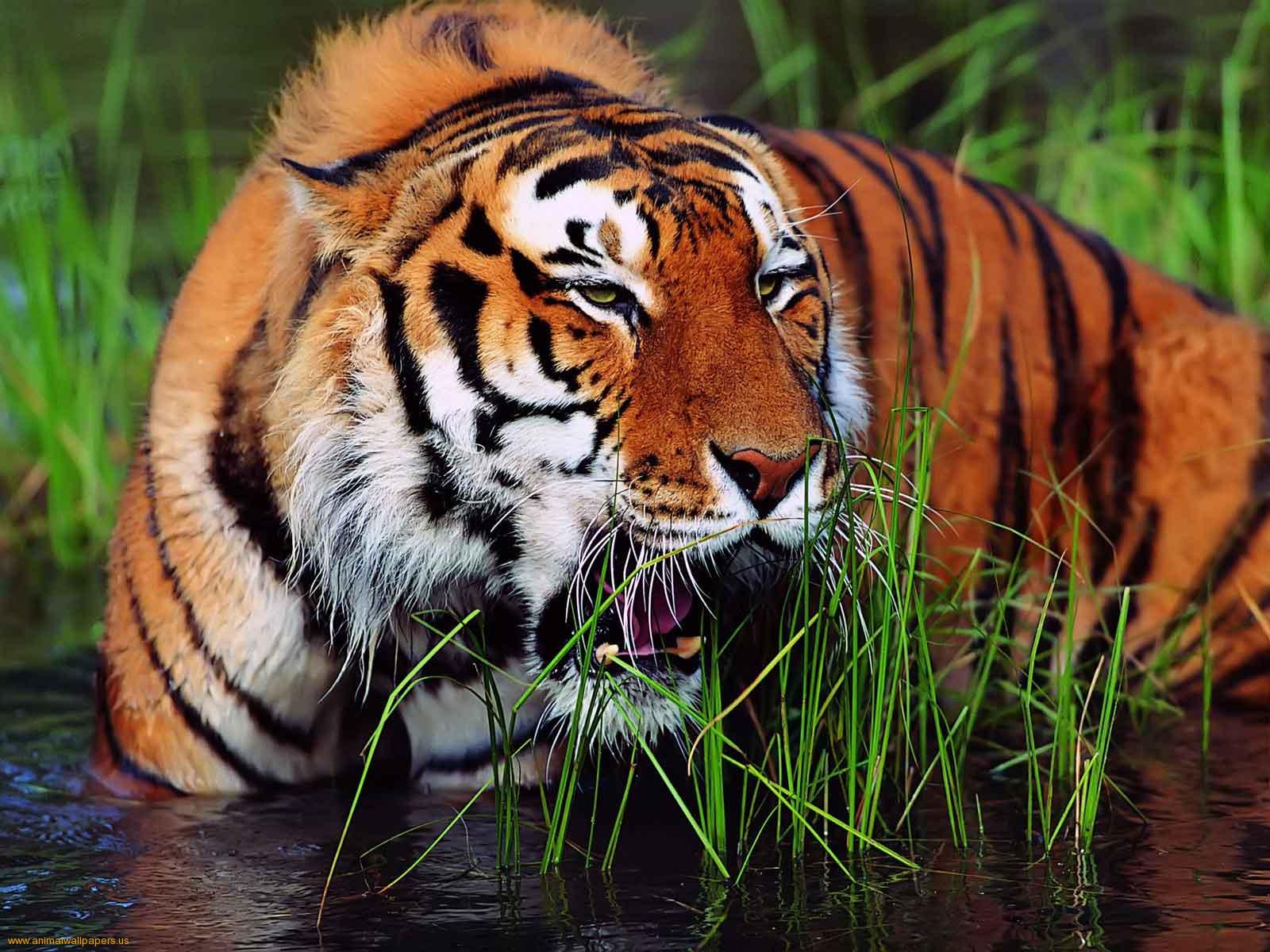
Royal Bengal Tiger

Royal Bengal Tiger


Royal Bengal Tiger